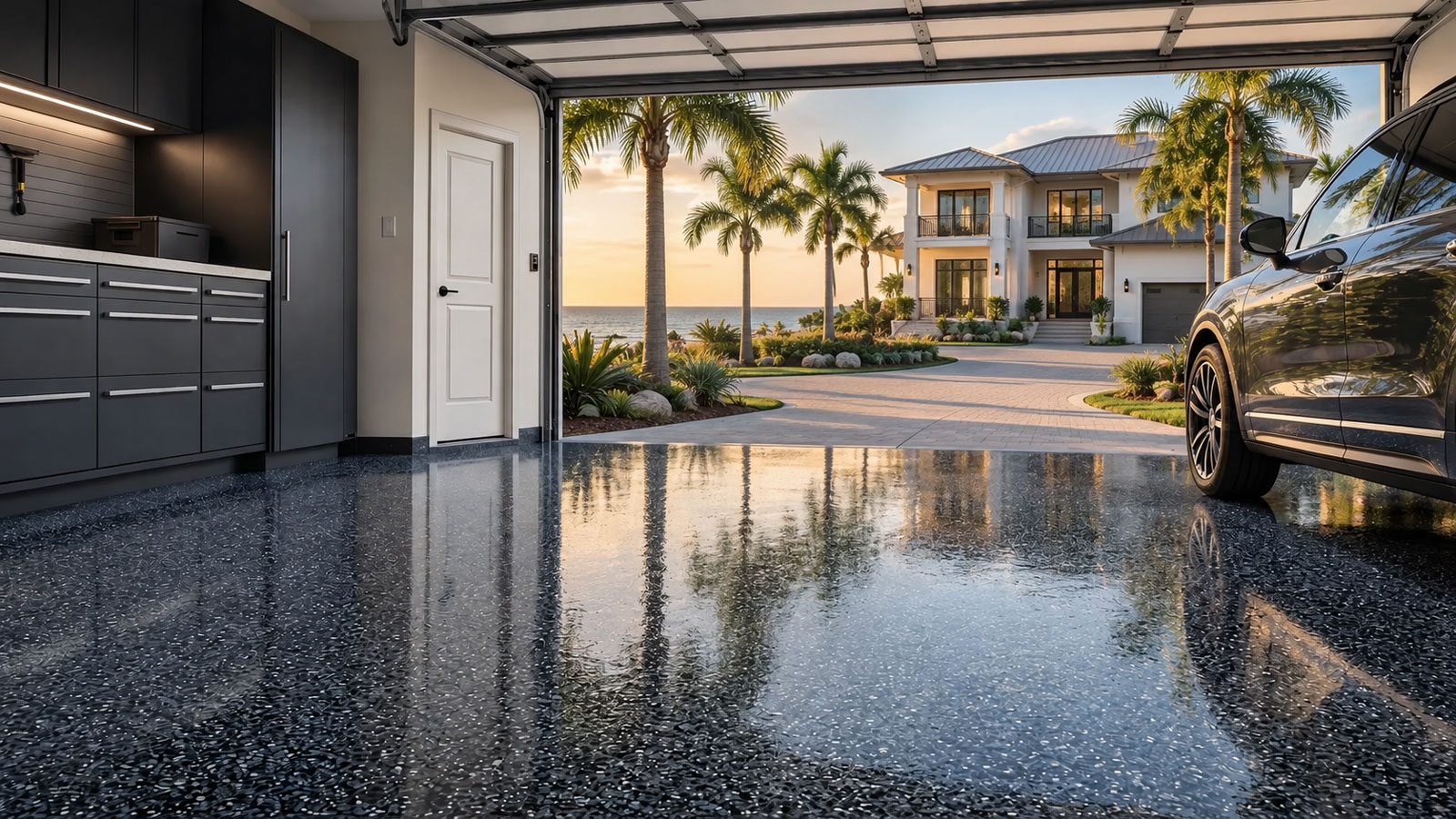
Garage Floor Coating in SouthWood, FL
Garage floor coating guidance for SouthWood homeowners considering epoxy, polyaspartic, or decorative flake systems.
Floor Coating Guidance for SouthWood, FL
SouthWood is a planned community about five miles southeast of downtown Tallahassee, with a distinctly organized network of homes, parks, alleys and shared facilities. The community association describes Central Park Lake and its walking trails, while the Capital Region Community Development District manages alleyways and stormwater facilities. Leon County records describe SouthWood's original Development of Regional Impact order in 1999 and subsequent amendments. Those documented land-use arrangements matter to garage access and drainage expectations, but they do not prove the condition of any home's concrete.
A public planning record from 2024 described the SouthWood development at approximately 3,222 acres and discussed stormwater master planning. The district's maintenance responsibility applies to community infrastructure rather than every private garage entrance. If water enters one garage during rain, inspect driveway grade, roof runoff and threshold details directly. A coating can help simplify cleaning on sound concrete but cannot correct a shared stormwater facility or a driveway that directs water inside.
SouthWood homeowners may have attached garages, alley-access arrangements or storage-heavy spaces used for everyday parking and recreation. A reliable epoxy, polyaspartic or flake installation begins by checking the floor for sealers, cracks, moisture suitability and surface profile. Select coating layers and texture around real household use and the time the garage can remain cleared, not on an unsupported promise of rapid cure.
Local Context
SouthWood's roughly 3,222-acre planned-development history dates to a 1999 intergovernmental approval; its community development district maintains alleyways and stormwater facilities. Those public responsibilities should be distinguished from the condition of a homeowner's private garage.
What Affects the Cost of a Garage Floor Coating?
The same measured garage area can carry different preparation and access needs in SouthWood. Alley approaches, storage, previously applied products and actual slab condition matter as much as square footage.
Because the community has organized stormwater facilities, it is especially important to separate the district's infrastructure from any water problem at one threshold. A coating estimate should price surface work, not imply responsibility for drainage outside the slab.
- Alleyway and equipment access: SouthWood's district maintains community alleyways. An installer should inspect the particular garage approach, equipment staging and debris removal plan rather than assuming every property has identical front-drive access.
- Curing materials or sealers: Planned-community construction can include newer pours and later changes. Check for surface treatments and actual cure history before deciding on grinding and bonding requirements.
- Garage threshold and runoff: The CDD manages public stormwater infrastructure, but private door and driveway geometry varies. Active water entry needs property-specific attention before the coating work proceeds.
- Cracks and slab preparation: Cracking, patches, pitting and weak surface material affect repair scope. A coating cannot fix movement, and repairs should be based on real inspection rather than an assumed neighborhood slab age.
- Use and storage clearance: Parking, bikes, tools and household storage determine how much must be moved. A garage that cannot be emptied or left unused during curing needs a realistic preparation and access plan.
- Finish texture and UV exposure: Decorative flake density, topcoat texture and sunlight at an open garage door can influence material selection. Compare complete system performance and maintenance instructions, not only color or advertised set time.
Call to discuss your garage, concrete condition, and project goals.
SouthWood's Planned Infrastructure and the Private Garage
SouthWood's Community Development District is a legally established special-purpose local government that maintains alleyways, stormwater facilities, parks and other common areas. Leon County's 2024 documentation traces the wider SouthWood DRI to 1999 and discusses later land-use and stormwater master-plan amendments. The community spans a large planned area rather than a single construction phase or identical type of garage.
That organization matters to a coating project chiefly through access and responsibility. The district may manage a public alley or stormwater facility, but an individual homeowner and contractor must inspect the garage's actual concrete, threshold and interior features. Public stormwater planning should not be mistaken for a guarantee that every garage stays dry or that a resin floor can correct drainage faults.
Some homes may require equipment to enter from an alley or a more constrained approach. Before work starts, discuss where grinders, vacuums and materials will be staged, whether neighbors' access must remain clear, and where vehicles can wait while the finish cures. Those are project-cost and scheduling questions that a generic floor-size calculator overlooks.
The concrete inspection remains central. Check past paint, curing compounds, cracks, patches and signs of moisture. A finished surface is only as dependable as the preparation beneath it, regardless of the quality of the neighborhood's shared infrastructure.
Everyday Water, Community Lakes and Coating Expectations
SouthWood's association identifies Central Park Lake as a neighborhood amenity, and its CDD publishes stormwater studies and facilities responsibilities. These features are genuine parts of the community's infrastructure, but proximity to a park lake does not establish internal slab moisture or flood risk at a particular home.
For an individual garage, watch what happens during rain. Water tracked on cars is different from water crossing a door sill or appearing from beneath a coating. The former creates a cleaning and traction question; the latter requires drainage investigation or appropriate substrate testing before any resin system is recommended.
A finished garage floor cannot repair runoff routing outside the building, prevent hydrostatic pressure or solve cracks that continue to move. Where persistent moisture is evident, the installer should state what evaluation was performed and what limits apply to the proposed coating. If water entry is active, it may be appropriate to postpone a decorative finish until the underlying issue is addressed.
For normal household parking and equipment, texture, topcoat maintenance and curing are the useful finish choices. Ask to see physical flake samples and compare whether a smoother or rougher floor is practical for sweeping and washing. The right system is chosen after confirming concrete suitability, not because a planned community has attractive amenities.
Frequently Asked Questions
Does SouthWood's CDD maintain my private garage floor?
No. The district describes responsibilities for common infrastructure such as alleyways and stormwater facilities. A private slab needs its own inspection, preparation and owner-contractor scope.
Will a garage coating resolve water coming in from an alley approach?
No. Water entering from a driveway or threshold is a separate grading or drainage matter. The coating contractor should verify concrete suitability once active water entry is addressed.
Can I assume a SouthWood garage has a newer coating-ready slab?
No. The broader planned development spans multiple phases, and a slab's actual pour history, sealers and condition require confirmation. Mechanical surface preparation can still be needed.
Are flake floors useful for family bikes and parking?
They can be appropriate on sound prepared concrete, but the texture should fit cleaning, wet tires and equipment movement. Ask for a real sample and complete system details.
What should a SouthWood installation quote cover?
Include equipment access, storage clearance, surface grinding, old-coating removal, crack treatment, moisture checks where indicated, finish layers and the date vehicles may safely return.